

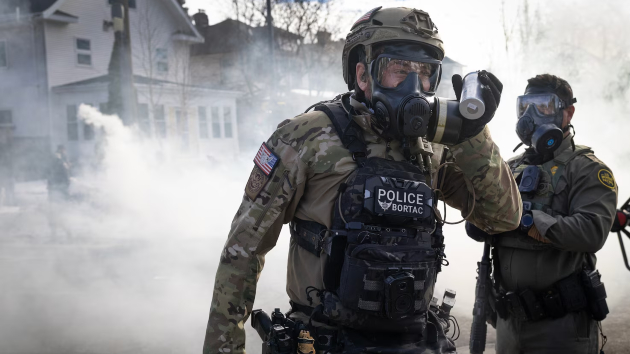
(MINNEAPOLIS) — President Donald Trump threatened to invoke the Insurrection Act to send in federal troops as protests unfold in Minneapolis against Immigration and Customs Enforcement operations.
“If the corrupt politicians of Minnesota don’t obey the law and stop the professional agitators and insurrectionists from attacking the Patriots of I.C.E., who are only trying to do their job, I will institute the INSURRECTION ACT, which many Presidents have done before me, and quickly put an end to the travesty that is taking place in that once great State,” Trump wrote in a social media post.
Democratic officials in Minnesota have decried ICE’s presence after two shootings involving federal law enforcement in the span of a week. Gov. Tim Walz called the ICE operations a “campaign of organized brutality against the people of Minnesota by our own federal government” and encouraged residents to “protest loudly, urgently, but also peacefully.”
Trump previously threatened to invoke the 1807 law, which hasn’t been used in over 30 years, last June amid protests in Los Angeles over the administration’s immigration crackdown and deployment of the National Guard and again in October for Chicago.
What to know about the Insurrection Act
Generally, the use of federal troops on U.S. soil is mostly prohibited. The 1878 Posse Comitatus Act limits the military from being involved in civilian law enforcement unless Congress approves it or under circumstances “expressly authorized by the Constitution.”
One exception is the Insurrection Act, a law signed by President Thomas Jefferson in 1807.
The Insurrection Act states, in part: “Whenever there is an insurrection in any State against its government, the President may, upon the request of its legislature or of its governor if the legislature cannot be convened, call into Federal service such of the militia of the other States, in the number requested by that State, and use such of the armed forces, as he considers necessary to suppress the insurrection.”
Another provision states it can be used “whenever the President considers that unlawful obstructions, combinations, or assemblages, or rebellion against the authority of the United States, make it impracticable to enforce the laws of the United States in any State by the ordinary course of judicial proceedings.”
Some legal experts have warned the law is overly broad and vague, and there have been various calls for it to be reformed to provide greater checks on presidential power.
The Insurrection Act has been invoked in response to 30 crises over its history, according to the Brennan Center for Justice, including by presidents Dwight D. Eisenhower and John F. Kennedy to desegregate schools after the Supreme Court’s landmark ruling in Brown v. Board of Education.
Most of its uses involved federal troops being deployed, though a few situations were resolved after troops were ordered to respond but before they arrived on the scene, the Brennan Center noted.
When it was last used in 1992 by President George H.W. Bush to send the National Guard to Los Angeles, it was at the request of then-GOP Gov. Pete Wilson as riots exploded in the city after the acquittal of white police officers charged in the beating of Rodney King.
Invoking the act without coordination with state officials is something that hasn’t been done since President Lyndon B. Johnson in the 1960s to deal with civil unrest.
Copyright © 2026, ABC Audio. All rights reserved.


