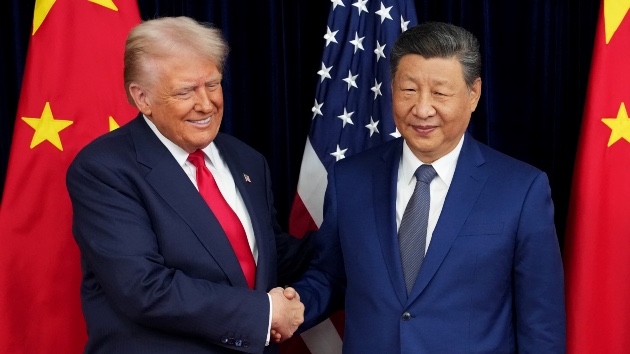
(WASHINGTON) — When President Donald Trump arrives in Beijing next Thursday, he’ll be the first U.S. president to set foot in China in nearly a decade. The last visit was Trump’s own, in 2017.
He arrives in a very different position than he expected: the trip was originally scheduled for earlier this spring, then postponed because of the Iran war.
Trump had said the war would only last four to six weeks. Instead, there’s no end in sight with the the Strait of Hormuz remaining closed and U.S. gas prices surging — as the president faces record-low approval ratings.
That backdrop has flipped the leverage dynamic, according to experts who study the region.
The leverage flip
Beijing would have preferred this war never started — the energy disruption and the hit to global demand are real headaches for an export-dependent economy, experts say. But they say the conflict has handed Xi a relative advantage: Trump now has too many fires to put out at home and abroad to risk another escalation cycle with China.
“China is a relative bright spot in Trump’s foreign policy right now,” said Jon Czin, a former director for China at the National Security Council.
The longer the Iran war drags on, Czin argued, the more it minimizes the chance of another economic confrontation — Beijing has also already demonstrated it can retaliate — as it did with tariffs and rare earth export controls — and the administration backed down before.
Both sides are still trying to eke out an edge in the run-up. The Treasury Department recently sanctioned Chinese oil refiners and shipping firms tied to Iranian crude to cut off funding. In an unprecedented move, Beijing invoked a “blocking rule” for the first time, directing Chinese companies not to comply with sanctions on Chinese oil refiners.
Daniel Shapiro, a former deputy assistant secretary of defense for the Middle East, points out the war has reduced the U.S. military posture in the Indo-Pacific with long-term consequences for deterring China and defending Taiwan.
“Trump’s position and leverage at the summit is considerably weaker if he goes to Beijing with the war still unsettled, or even with renewed escalation. And the Iranians know that. So they are whittling down the terms to end the war to something much more modest than what Trump originally envisioned,” Shapiro wrote in a post on X.
What Trump wants
The administration clearly wants Beijing to use its influence over Tehran. Secretary of State Marco Rubio this week urged Beijing to use the Iran’s foreign minister’s visit to China earlier this week to press Tehran on reopening the Strait of Hormuz.
“I hope the Chinese tell him what he needs to be told,” Rubio said when asked about China’s top diplomat meeting with Iran’s foreign minister. “And that is that what you are doing in the strait is causing you to be globally isolated. You’re the bad guy in this.”
Beyond the war in Iran, Trump will be looking for wins on trade and investment: For instance, Chinese commitments to buy Boeing planes and U.S. agricultural goods as well as an extension of the trade truce reached during the last Trump-Xi meeting in South Korea last year, according to experts.
The administration also wants China to continue its pause on rare earth export controls, analysts say. U.S. Trade Representative Jamieson Greer has also proposed a “Board of Trade” to manage economic ties between the countries and goods the two sides are trading.
What Beijing wants — and what it doesn’t
Here’s the gap between the administration’s public framing and what analysts who study China most closely are saying: Beijing doesn’t actually plan to deliver much on Iran or get deeply involved.
Beijing’s statement after the meeting with the Iranian Foreign Ministry was carefully worded to not blame Iran for the crisis while also calling for greater efforts to open the Strait of Hormuz.
“The Chinese are not interested in assuming any kind of direct role in the conflict,” according to Patricia Kim, senior fellow at the Brookings Institution. “They see this as a problem that the United States needs to solve, and they have no interest in intervening on Tehran’s behalf.”
Czin’s read is similar. While Beijing’s meeting with the Iranian foreign minister this week let it “posture as peacemakers,” he says the Chinese don’t want Iran to take up too much summit time. His analog: even on North Korea, right on China’s doorstep, Beijing rarely puts real pressure on Pyongyang.
China’s energy buffer is part of why the urgency is lower than the Trump administration assumes. Beijing has built strategic oil reserves, invested heavily in green energy, and can shift to domestically produced coal. The bigger risk for China isn’t the energy crunch itself.
“The bigger issue for China is the secondary and tertiary effects from this conflict,” Czin said — such as a war-driven global slowdown that hits the Southeast Asian and European consumers that Chinese exports depend on.
What Beijing actually wants from the summit is more stability: lock in the trade truce, push back on U.S. export controls on advanced technology and ease restrictions on Chinese investment in the U.S.
What’s unclear is how hard Xi will push Trump on Taiwan. Any small shift in U.S. declaratory language on Taiwan would be significant, though Czin is skeptical Trump would stick with new wording even if he agreed to it.
Bottom line
Expect fanfare, expect deliverables on the margins — purchase commitments or a possible Board of Trade announcement — and don’t expect breakthroughs on the hard issues, experts say.
The summit’s significance is less in what it produces than in what it preserves: a tenuous stability that both leaders, for different reasons, want to keep intact through the rest of the year.
Copyright © 2026, ABC Audio. All rights reserved.