

(WASHINGTON) — Congress has approved legislation for a funding fix that fully supports the World Trade Center Health Program and prevents a projected multibillion-dollar shortfall that threatened the program’s future.
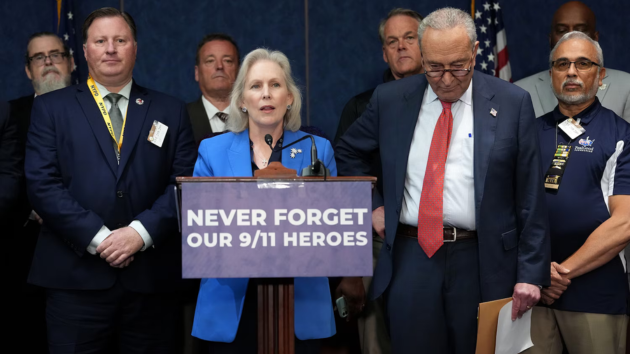
At a press conference Thursday morning, Sen. Kirsten Gillibrand, D-N.Y., highlighted the action as a critical step toward protecting long-term care for those sickened by toxic exposure after the Sept. 11 attacks.
“Fully funding the World Trade Center Health Program honors our promise to never forget 9/11 survivors and the brave first responders who put their lives on the line for our country,” Gillibrand said.
Since its creation in 2011 through an act of Congress, the program reports it has helped over 150,000 individuals get care and medical monitoring. Gillibrand said the package will fully fund the program through 2040.
The new measure updates how the program is financed, allowing it to meet rising medical costs and growing enrollment without the risk of sudden funding gaps.
Supporters say the change provides long-term stability for the thousands of people whose health was harmed by exposure to toxic chemicals after the Sept. 11 terror attacks in New York, Pennsylvania, and Washington, D.C.
“Making sure our 9/11 first responders and survivors have the resources they need to cope with the long-term health effects from toxic exposure has been one of my top priorities for my entire service in Congress,” Gillibrand said. “I am relieved that, after years of fighting tirelessly for its passage, this funding has been signed into law.”
The World Trade Center Health Program provides medical monitoring and treatment for first responders, cleanup workers, and community members affected by 9/11-related exposure. Advocates stressed that stable funding is critical not only for current patients but also for people who may develop related illnesses years or decades later.
Doctors, responders, advocates, and survivors have long warned that the program faced a looming financial crisis.
Enrollment has continued to grow as more people develop cancers and chronic conditions linked to toxic dust and debris, while aging patients require more complex care, Benjamin Chevat, executive director for nonprofit Citizens for the Extension of the James Zadroga Act, told ABC News.
An outdated funding formula failed to reflect those realities, raising concerns that treatment could be delayed or limited, advocates cautioned.
Still, supporters say funding alone does not resolve all of the program’s challenges.
“Finally, fully funding the World Trade Center Health Program after so many years is a real accomplishment, for the 9/11 responders and survivors who walked the halls of Congress and called their representatives, and for Rep. Andrew Garbarino and Sen. Gillibrand among others who worked to get it done,” Chevat said.
The James Zadroga 9/11 Health and Compensation Act is named after a New York City Police Department officer whose 2006 death was linked to exposures from the World Trade Center disaster.
Chevat said that some challenges remain for the program.
Certification of new conditions has slowed, staffing shortages persist at some clinical sites, and administrative backlogs have delayed care for certain patients, Chevat said. Addressing these issues will ensure the program can fully deliver on its mission, he added.
Dr. Joseph Wendt, a member of the ABC News Medical Unit, contributed to this report.
Copyright © 2026, ABC Audio. All rights reserved.


