

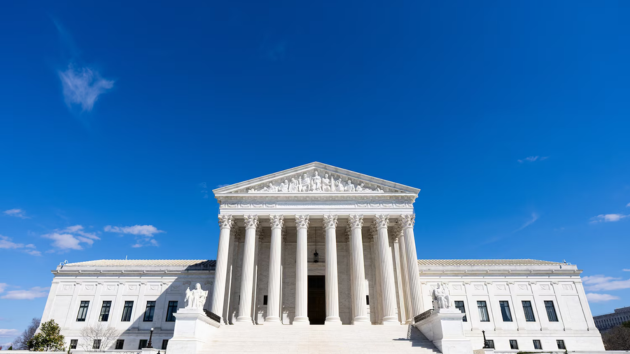
(WASHINGTON) — The Supreme Court appears poised to allow President Trump to turn away asylum seekers who approach ports of entry along the U.S.-Mexico border, a decision which would reverse a lower court ruling that the policy likely violates federal law and international treaties.
A majority of the court’s conservative justices signaled during oral arguments in the case Tuesday that the administration should have broad leeway over border control and that asylum seekers who have not yet stepped foot on U.S. soil probably do not have a legal right to file a claim seeking protection.
“Do you think someone who comes to the front door of a house and knocks at the door has arrived ‘in’ the house?” Justice Samuel Alito asked. “The person may have arrived ‘at’ the house.”
Immigrant advocates insist the Immigration and Nationality Act, which says a noncitizen who “arrives in the U.S. … at a designated port of arrival” must be allowed to apply for asylum, includes those who have “reached the threshold” of America.
“If an immigration officer determines that an alien who is arriving in the United States has expressed a fear of future persecution, then the immigration officer shall refer them for a credible fear interview,” argued Kelsi Corkran, an attorney supporting asylum seekers.
From the start of his second term, Trump has effectively blocked the entry of all noncitizens at the southern border, including those seeking to apply for refuge from credible fears of violence and persecution.
“You can’t ‘arrive in’ the U.S. while you’re still standing in Mexico,” argued Assistant Solicitor General Vivek Suri. “It is entirely lawful for the executive branch to prevent aliens from reaching U.S. soil and claiming those protections.”
The dispute largely turns on competing interpretations of what it means to “arrive in” the country.
“How close do you have to be to the border?” asked Justice Amy Coney Barrett. “If it’s not crossing the physical border, what is the magic thing or the dispositive thing that we’re looking for where we say, ah, now that person we can say arrives in the United States?”
Justice Brett Kavanaugh suggested that regardless of where the line is drawn, the law stipulates that the government can prevent people from filing an asylum claim if it wants to. “The government’s presumably going to stop you on the other side of that line and prevent you from getting to wherever the line is. Right?” he asked.
The court’s three liberal justices were critical of the Trump administration’s interpretation of the law.
“Imagine a polite asylum seeker who wants to do everything by the book,” posited Justice Ketanji Brown Jackson. “He approaches the border but does not cross, precisely because the law says you are not supposed to enter the U.S. without authority. Why on earth would Congress have intended or meant for his asylum request to be discarded, not taken seriously, not entertained, but someone who manages to enter the U.S. unlawfully…and requests asylum gets their application entertained? “
“That doesn’t seem to me to make any sense,” Jackson added.
At the heart of the case is the so-called “turn back” policy from Trump’s first term that kept asylum seekers waiting in Mexico as a method of “metering” access at border crossings that faced overcrowding. Border officials contend it was a temporary policy, imposed only when conditions required.
While the administration voluntarily discontinued the practice in 2021 after a lower court deemed it unlawful, the government now wants the justices to approve the ability to reinstate the policy if necessary. Trump has invoked alternate legal authorities to support his current border crackdown.
Melissa Crow, director of litigation at the Center for Gender & Refugee Studies, an immigrant rights group representing several asylum-seeker plaintiffs, said a ruling for the administration could have a major impact, even if not immediate.
“We have no doubt the administration is seeking a decision that will give them even more leeway to restrict the rights of people seeking asylum,” Crow said.
Tens of thousands of asylum seekers who arrived at the U.S. southern border during Trump’s first term were forced to remain in Mexico for weeks or months in sometimes harrowing conditions in hopes they might have a chance to be interviewed about their fears of persecution.
Nicole Ramos, border rights project director at Al Otro Lado, an immigrant rights group and plaintiff in the case, says Congress had a more nuanced view when it drafted the law following the U.S. failure to accept Jewish refugees from the Holocaust.
“The right to seek asylum at the border is a legal right and a moral right,” Ramos said. “The stakes are not theoretical. They are measured in lives.”
One of those lives was Benito, a Mexican asylum seeker who declined to give his last name to protect his identity and spoke through a translator at an event hosted by Al Otro Lado.
“I was partially tortured, had a lot of lesions, and emotional harm, and traumas and I’m still healing from that,” he said of the violence he was trying to escape. “I knew I could apply for asylum in that moment, on the side of Mexico, and so I did everything correctly. I came close; I told the [U.S.] immigration agents that I needed to apply for asylum because I was scared and thought I would be killed.
“I had scars on my body, on my face, and my head,” he said, “but they said to me that they couldn’t help me, couldn’t accept me.”
The court is expected to issue a decision on the Trump administration’s bid to resurrect the “metering” and “turn back” policy by the end of June.
Copyright © 2026, ABC Audio. All rights reserved.


