

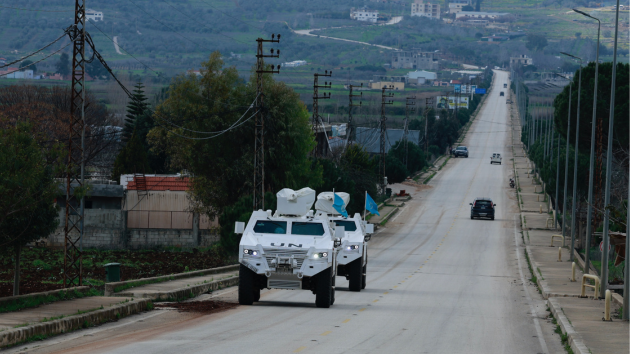
(LONDON) — United Nations peacekeepers operating in southern Lebanon have been fired upon around 20 times since the resumption this month of hostilities there between Israel and the Iranian-backed Hezbollah militia, a spokesperson for the force told ABC News.
Around 7,500 personnel from 48 countries make up the U.N. Interim Force in Lebanon (UNIFIL) mission, tasked with monitoring the cessation of hostilities between Israel and Hezbollah in support of the Lebanese Armed Forces (LAF).
UNIFIL peacekeepers have regularly been caught in the crossfire between the warring sides in recent years, with intense bouts of violence in southern Lebanon touched off by the Oct. 7, 2023, attack by Iranian-backed Hamas militants into southern Israel and the subsequent war in the Hamas-ruled Gaza Strip, which Hezbollah joined in support of Hamas.
Limited respite secured by a November 2024 ceasefire deal between Israel and Hezbollah has now given way to another round of conflict, sparked by the joint U.S.-Israeli attack on Iran in late February. Hezbollah joined the conflict on March 2, firing projectiles into northern Israel, seemingly in support of their patrons in Tehran.
Hezbollah leader Naim Qassem said the attacks were a response to Israeli “transgressions” since the signing of the 2024 ceasefire, which he described as “excessive.”
The Israel Defense Forces said this week that the group had fired over 2,000 rockets and drones toward northern Israel during the conflict to date. A 27-year-old Israeli woman was killed by a Hezbollah rocket on Tuesday.
More than 1 million people in Lebanon have been displaced by Israel’s offensive and evacuation orders, according to U.N. data. More than 1,000 people have been killed by Israeli attacks in Lebanon in the latest round of fighting, the country’s health ministry said.
Peacekeepers are now back in the line of fire from both sides. Of the roughly 20 firing incidents so far recorded since Feb. 28, UNIFIL spokesperson Kandice Ardiel told ABC News that a preliminary count found that around 60% were of unknown origin, 25% were attributed to the IDF and 15% to non-state actors on the Lebanese side — “most likely” Hezbollah.
Four UNIFIL peacekeepers have so far been injured in two separate incidents, Ardiel said. Three of the injuries were minor and one was severe. The peacekeeper who sustained severe injuries is now in a stable condition, she said.
UNIFIL has not yet established responsibility for the incidents that caused casualties, Ardiel added.
However, the IDF has acknowledged responsibility for one incident, when it said that on March 6 an Israeli tank mistakenly fired on a UNIFIL position, wounding Ghanaian peacekeepers.
Hezbollah is not known to have claimed responsibility for any recent attacks on UNIFIL forces.
Ardiel credited UNIFIL’s security measures for the relatively low number of casualties to date.
Even the force’s headquarters in the coastal city of Naqoura, she said, “has been hit with bullets, shrapnel, fragments of intercepted projectiles.” On Monday, the headquarters was also struck by “a rocket fired by a non-state actor — likely Hezbollah,” Ardiel said.
UNIFIL was first deployed to Lebanon in 1978, tasked with monitoring the ceasefire that ended an Israeli incursion into the south of the country.
Since 2006, UNIFIL has been tasked with monitoring the cessation of cross-border hostilities following a major conflict between the IDF and Hezbollah and supporting the planned — but ultimately unrealized — Hezbollah withdrawal from the area and the redeployment of the LAF in its place. That plan was set out by U.N. Security Council resolution 1701.
The U.S.-brokered 2024 ceasefire between Israel and Hezbollah restated UNIFIL’s role in supporting the LAF’s disarmament of all non-state armed groups — prime among them Hezbollah — south of the Litani River. The LAF claimed to have achieved the first phase of this plan in January, but Hezbollah’s daily fire toward Israel seems to undercut those claims.
Israeli forces retained control of five positions on Lebanese territory and continued strikes against alleged Hezbollah targets all across Lebanon despite the ceasefire deal. Hezbollah was vocally critical of the continued Israeli presence and attacks but did not retaliate.
The resumption of hostilities earlier this month prompted a major new Israeli campaign. Israeli Defense Minister Israel Katz said he instructed the IDF to “accelerate the destruction of Lebanese homes in the line of contact villages, to thwart threats to Israeli communities, in accordance with the model of Beit Hanoun and Rafah,” referring to Israel’s destruction of Gaza towns during operations against Hamas.
Katz sent thousands of additional troops into southern Lebanon, vowing to seize the territory up to the Litani River to create what he called a “defensive buffer.” The effort included the destruction of several bridges along the Litani, which Katz claimed were being used by Hezbollah.
Ardiel said the destruction of those bridges — which she described as “vital arteries” — would complicate UNIFIL and LAF efforts in the area.
“While peacekeepers are well-prepared and supplied and can continue daily activities, we rely on these arteries for essential logistical movements, including troop rotations,” Ardiel said, urging all actors to avoid harm to civilians and damage to civilian infrastructure.
UNIFIL troops, she added, have facilitated the safe movement of around 100 civilians from dangerous areas.
UNIFIL peacekeepers remain in all their positions, Ardiel said, but, “due to the volatile and dangerous security situation, our movements are heavily restricted. We are no longer conducting patrols in the way we used to, so our monitoring is more limited than it was before.”
“Our patrols are now focused on areas around our positions, to ensure our peacekeepers are safe and discourage armed groups from using our positions as cover for their activities,” she added.
Copyright © 2026, ABC Audio. All rights reserved.


