Evergy’s proposed high-voltage transmission line crossing southern Kansas has drawn opposition from landowners and environmental advocates, as regulators move toward a final decision expected by the middle of next month.
A series of April filings has sharpened the debate in the case before the Kansas Corporation Commission, with initial post-hearing briefs filed April 6 and reply briefs submitted the following week.
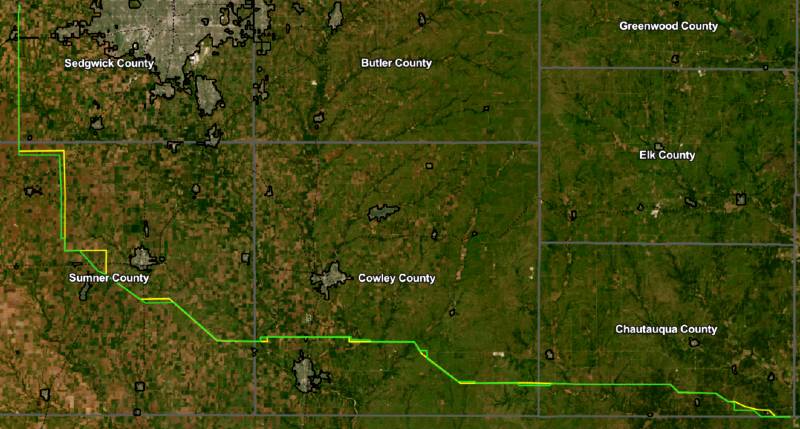
The project, known as the Buffalo Flats to Delaware transmission line, calls for construction of a 133-mile, 345-kilovolt line running through Sedgwick, Sumner, Cowley and Chautauqua counties as part of a regional grid upgrade.
The line would enter Cowley County near the Sumner County line between 232nd and 242nd roads, pass just north of SCK Health Medical Center, then continue east a few miles north of Arkansas City before turning south as it continues east into Chautauqua County.
Opponents say the line would cut through portions of the Flint Hills and Tallgrass Prairie while offering little in return to the communities it crosses.
According to filings, the project would not include substations or direct service connections in the affected counties, meaning electricity would pass through the area without being distributed locally.
Landowner intervenors argue that leaves local communities carrying the burden without seeing direct benefits.
“The Kansas customers who pay the dearest price in terms of providing access and a pathway… receive the least amount of benefits,” opponents wrote in their April 6 filing.
They also argue the project would “bisect and forever mar and degrade the Kansas Flint Hills and Tallgrass prairie,” raising concerns about long-term environmental impacts.
Opponents further contend the line primarily serves demand outside Kansas, pointing to testimony suggesting the project is aimed at improving reliability in southwest Missouri.
“This was a project to benefit Missouri,” intervenors wrote.
Evergy disputes that a lack of direct local benefit should be decisive, arguing state law requires regulators to consider benefits to both Kansas and out-of-state consumers, as well as broader economic impacts, rather than focusing solely on the counties where the line is built.
The project carries an estimated cost of roughly $490 million, with expenses shared across a multi-state grid.
Evergy and regulatory staff say the line is necessary to improve reliability and reduce strain on the regional power grid, particularly during extreme winter weather. Continue below ad.
In filings submitted in mid-April, Evergy said the project would help prevent outages, improve voltage stability and reduce congestion on existing transmission lines, resulting in long-term cost savings for customers.
The company also disputes claims that environmental concerns were ignored, stating the selected route minimizes impacts and includes plans to restore affected land following construction.
Regulatory staff have recommended approval of the project, calling the proposed route “necessary and reasonable” under state law.
Still, opponents argue key questions remain, including whether the project is truly needed and whether alternative routes — including options outside the Flint Hills — were fully considered.
A reply brief filed April 13 framed the decision in stark terms, stating regulators must determine whether to act as “a steward of the last remaining vestiges of the Tallgrass Prairie” or approve a project that could cause irreversible impacts.
The Kansas Corporation Commission is expected to issue a final decision by May 13.